Tools and resources
Read tools
For every tree in GRAMPS_MCP_TREES, the server reads that Gramps Web API
instance's openapi.json at startup and generates the read tools from it.
All the trees share the same tools, and each tool takes the tree it is for (the
id that list_trees gives; with a single tree it can be left out). Eight read
tools are exposed, along with list_trees:
| Tool | Reads |
|---|---|
list_trees |
The trees you can use, as {id, name}. The list comes from GRAMPS_MCP_TREES, not from Gramps: a Gramps user cannot list trees, only a site admin can. |
list_objects |
A page of objects of one type, with filters, sorting and the profile/extend options. |
get_object |
One object of any type, from its handle. |
query_objects |
Objects of one type matched by a GOQL where_expr, with select, order_by, limit and count. |
get_search |
Full-text search across all types. |
get_relation, get_relations |
How two people are related, and every way they are. |
get_person_timeline, get_family_timeline |
The events around a person or a family. |
list_objects, get_object and query_objects take an object_type
(people, families, events, places, citations, sources,
repositories, notes, tags, media). Gramps Web API defines the same
operation for each type, so the server merges them instead of listing ten
copies of each: the three tools cost about as much context as one set. Their
parameters, descriptions and types are those of the backend's spec. If a type's
operation ever differs from the others in a future Gramps version, that type
keeps its own tools.
Reports, exports, imports, media files and thumbnails, DNA, tree administration
and the like are not exposed. GRAMPS_MCP_READ_TOOLS=all exposes every read
route of the backend as its own tool (about 90).
Gramps Web API version
The tools follow the Gramps Web API you run: nothing about its schema is copied
into this package. At startup the server checks the version in the backend's
spec. It refuses to start below 3.23 (when GOQL's MatchesQuery arrived) and
logs a warning above the newest version it is tested with, so a newer backend is
used rather than refused. The test suite runs against the minimum and the
latest published version.
No generated tool writes. Every other POST, PUT, PATCH and DELETE
(including merge, the bulk objects endpoints, transactions and chat) is
excluded, so a new write endpoint is never exposed by accident.
The write tool
apply_changes is the only way to change a tree; it takes the tree to change. It takes one set
of 1 to 20 operations, in order:
op |
Fields | Meaning |
|---|---|---|
create |
type, object |
Add the full object. _class may be left out; if given it must match type. Not for media. |
update |
type, handle, changes |
Merge changes, a nested object holding only the changed fields, into the current object. A list replaces the whole list. |
delete |
type, handle |
Delete the object. |
The object of a create is shown to the model with the schema of its type,
read from your Gramps Web API's own OpenAPI document at startup (fields, types
and descriptions of Person, Family, Event, Place and so on, without the
fields the server computes). The server does not validate against it: Gramps
does, and is stricter. The schema is there so the model knows which fields exist.
It makes apply_changes the largest tool of a tree, about 28 KB of definition.
The description also asks for a place's lat and long, which the model
otherwise tends to leave out. It is a suggestion, not a check: a place without
coordinates is accepted.
type is one of people, families, events, places, citations,
sources, repositories, media, notes, tags. A create refuses media:
Gramps takes the file itself as the body of POST /api/media/ and derives the
checksum, path and mime from it, so a JSON object would be stored as the
file and every field it carries silently dropped. Add the media in Gramps Web,
then update it here to set its fields. Unknown keys are refused, as are
handle, _class and the read-only fields (backlinks, extended,
profile) in changes, a handle longer than 50 characters, and two operations
on the same object.
The server reads the current objects, builds a readable summary of every
change, and asks the user once to confirm, through MCP elicitation. The summary
names things instead of showing handles and raw fields: people, families and
events are named (through the API's profile=self, or from the objects created
in the same set), field names become words and a date changes as one line:
Apply these 4 change(s) to the tree?

1. Add event: Birth, 10 août 2010
2. Add person: Ileana Viveret
    - sex: female
    - events: Birth, 10 août 2010
3. Add family: family of Jérôme Benoît Viveret
    - father: Jérôme Benoît Viveret
    - children: Ileana Viveret
4. Edit person: Jérôme Benoît Viveret (I0001)
    - families: add family of Jérôme Benoît Viveret
The text is also valid Markdown, so clients that render it show a list with the details nested under each change.
A reference that is not in the tree shows as "a person that is not in the tree"
rather than a handle. Nothing is
written if the user declines or cancels, or if the client cannot ask: a client
without elicitation support gets not_applied and the tree is untouched.
Both ways of asking are supported: the question sent in the middle of the call
by clients on protocol versions before 2026-07-28, and the "input required"
result that the call returns, and the client answers by calling again, from
2026-07-28 on. In the second flow the server sends a digest of the summary
with its question, and counts the answer only if the summary it rebuilds on the
retry has the same digest. If an object changed while the user was deciding, the
user is asked again about what would now be written; after three tries, nothing
is written.
If the answer is not a confirmation, the result says what the client sent:
The user declined., The user dismissed the confirmation (cancel)., or
The client did not confirm: accept without confirming (content: ...) when a
client answered "accept" without the confirm field set to true. The server
logs one line per decision at INFO, with the client name and version and the
protocol version, for example apply_changes confirmation from Copilot 1.2
(protocol 2026-07-28): accept.
By default a client that cannot ask for confirmation writes nothing. Set
GRAMPS_MCP_CONFIRMATION=when-supported
to apply the changes directly for such clients instead; clients that can ask are
still asked.
The tool also carries _meta["anthropic/requiresUserInteraction"] = true, which
makes Claude Code show its own approval prompt on every call, whatever the
permission mode. That prompt shows the raw arguments; the readable summary
comes with the confirmation.
Changes are written in order. If one fails, the earlier ones are undone in a single call to Gramps' transactions endpoint, which applies the undo all or nothing and refuses it if an object has changed since.
The result has a status:
status |
Meaning |
|---|---|
applied |
Everything was written. Created objects come back with their handle. |
declined |
The user did not confirm. |
not_applied |
Nothing was written: the client cannot confirm (in required mode), or the first change failed. |
invalid |
The changes could not be planned, for example an unknown handle. |
rolled_back |
A change failed and the earlier ones were undone. |
partly_applied |
A change failed and the earlier ones could not be undone; the message says why. |
The preview shows the objects you name, not the ones Gramps updates as a consequence (editing a family also rewrites its members, deleting an event rewrites everyone who refers to it). The role of the service account still bounds what can be written: see Create a Gramps Web service account.
Excluded routes
These prefixes are never turned into tools:
| Prefix | Why |
|---|---|
/api/filters/ |
Saved (custom) filters are better kept out of an agent's hands. |
/api/token/ |
The server already handles authentication and token refresh. |
/api/users/ |
The server uses it itself for the membership check; user management is not for an agent. |
/api/facts/, /api/facts |
Not useful to an agent. |
/api/config, /api/oidc/config |
Server configuration is not useful to an agent. |
The list lives in EXCLUDED_ROUTE_PREFIXES in src/gramps_mcp/trees.py; the read-only rule is map_route in the same file.
Request handling
- Output schemas of the read tools are dropped, since Gramps' response schemas are too loose for strict validation to help.
- Authentication to Gramps Web is automatic. The server logs in once per tree and refreshes the token in the background.
Resources
| URI | Content |
|---|---|
gramps://goql-spec |
A guide to the Gramps Object Query Language (the same text is here), so an agent can write a valid where_expr for query_objects before calling them. |
Interactive card (experimental)
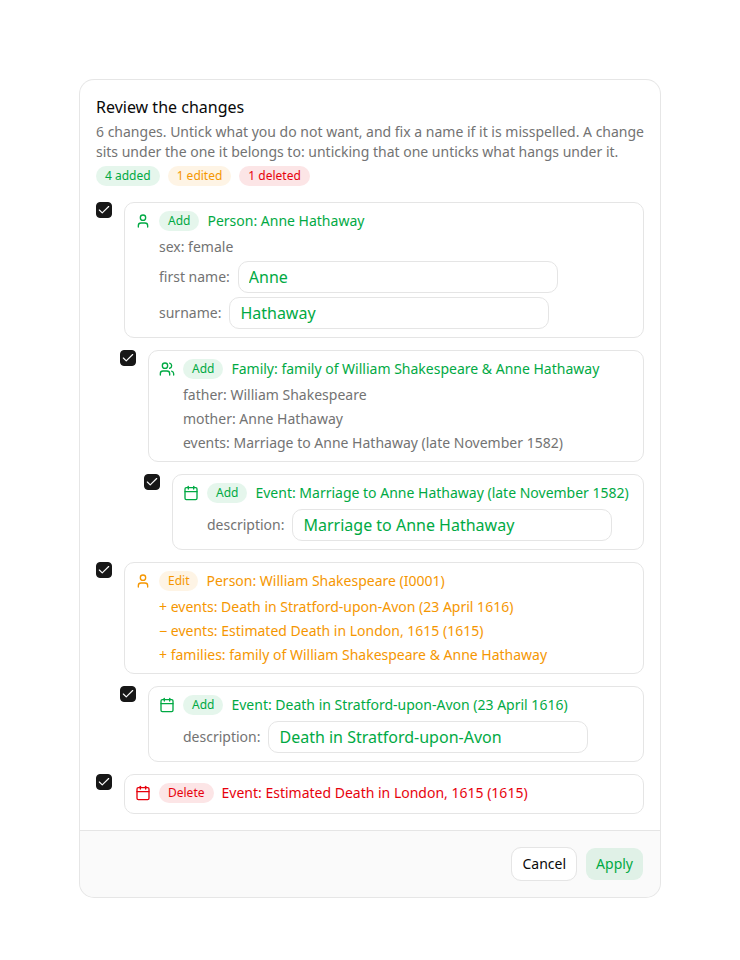
In clients that render MCP Apps, apply_changes shows its changes as a card
instead of asking for a confirmation. This lets clients without elicitation
support, such as Claude Desktop, confirm writes. Set GRAMPS_MCP_UI=off to
always ask for a confirmation instead:
Watch the end-to-end demo
Or interact with it directly in the embedded frame below:
- Tick or untick each change. The changes are shown as a tree: a change hangs under the one it belongs to. A birth hangs under its person and a note under the birth, a family under its mother and the child under the family. Unticking a change unticks everything under it, and ticking a change ticks what it hangs under. Ticking a prerequisite again does not tick back what hung under it.
What belongs to what is read from the fields of each object. A person's or
family's event_ref_list, and any note_list, citation_list and
media_list, belong to the object that lists them. A family needs the parents
it names and a child needs its family. Links that only record a relation
(family_list, child_ref_list, tag_list) make nothing depend on anything.
A reference to something reusable, such as an event's place, does not make
the event depend on it either: a new place that only one change refers to
hangs under that change, as it was made for it, and goes with it; one that
several changes refer to stands on its own. When a change is left out, it is
also taken out of the changes that are applied: unticking the child creates
the family without that child, unticking the birth creates the person without
it, unticking a place creates the event without a place, and an edit whose
only change was such a link is not sent.
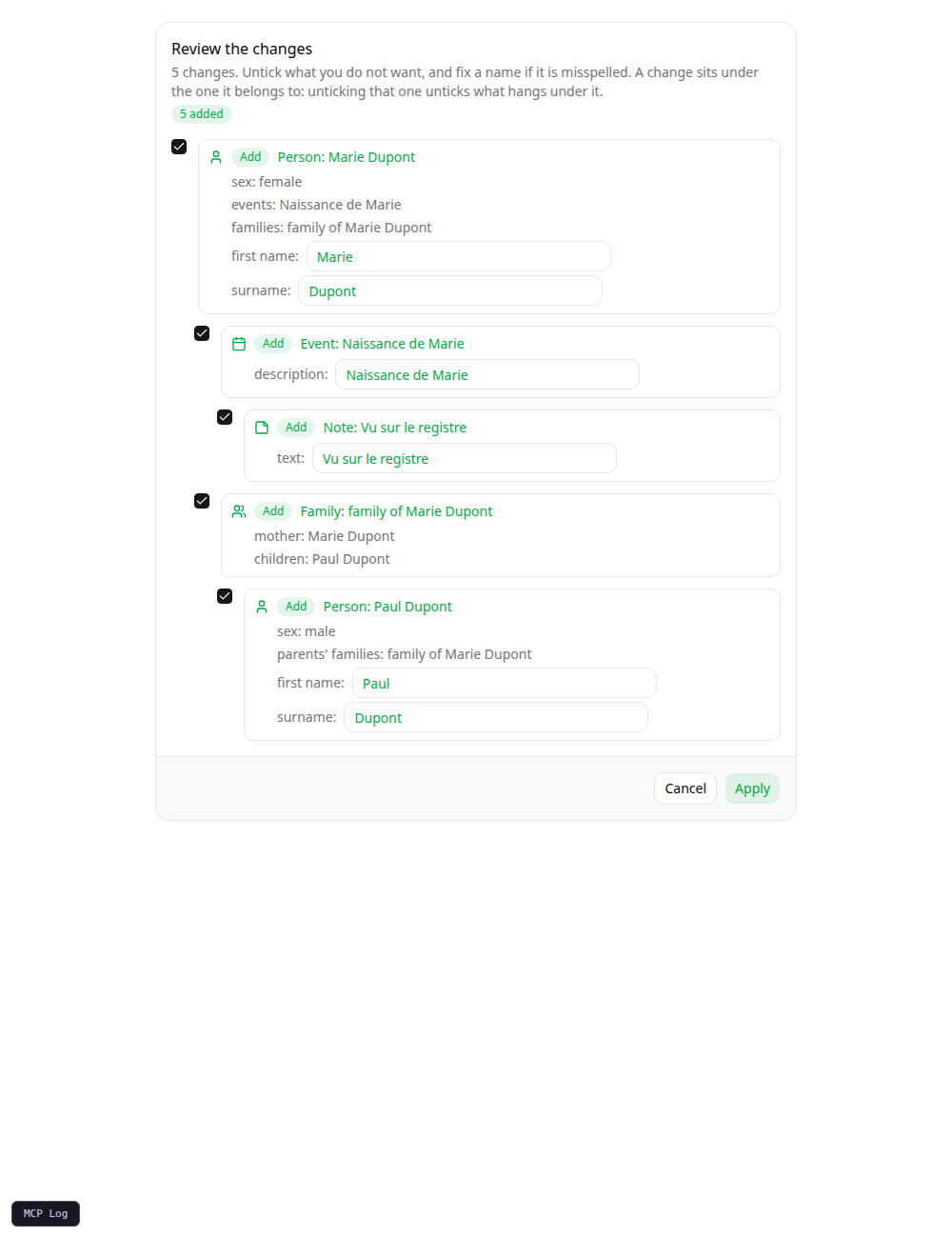
- Fix a name before applying: a first name, surname, event description, place name, note text, title. Only these text fields of a created object, or of an edited one that the change touches, can be edited, up to 500 characters. Dates, handles and references cannot.
- Apply calls
confirm_changes, a tool the host keeps away from the model (visibility: ["app"]). The server rebuilds the changes, refuses them if an object changed since the card was shown, checks the selection is consistent and the edits are allowed, writes what is selected, and the outcome is sent to the conversation as a message. Cancel writes nothing. - A card can be applied once, within 30 minutes. They are kept in memory, so a restart expires them: ask for the changes again.
A client that does not advertise MCP Apps gets the confirmation described above
(elicitation), as if the card did not exist. GRAMPS_MCP_UI=prefab-always shows
the card to every client; one that cannot render it then writes nothing.
Limits to know. The guarantee that the model cannot confirm for the user rests
on the host keeping confirm_changes out of the model's tool list, as the MCP
Apps specification asks; check it in your client. The card does not set Claude
Code's requiresUserInteraction mark, and apply_changes has no output schema
in this mode. The labels that name an object do not follow a name you are
editing until you apply.
Endpoint
The server speaks MCP's streamable HTTP transport at /mcp. With Google
sign-in enabled it also serves the OAuth metadata and authorization endpoints
that MCP clients discover automatically.